Truckload Solutions Engineered for Supply Chain Performance.
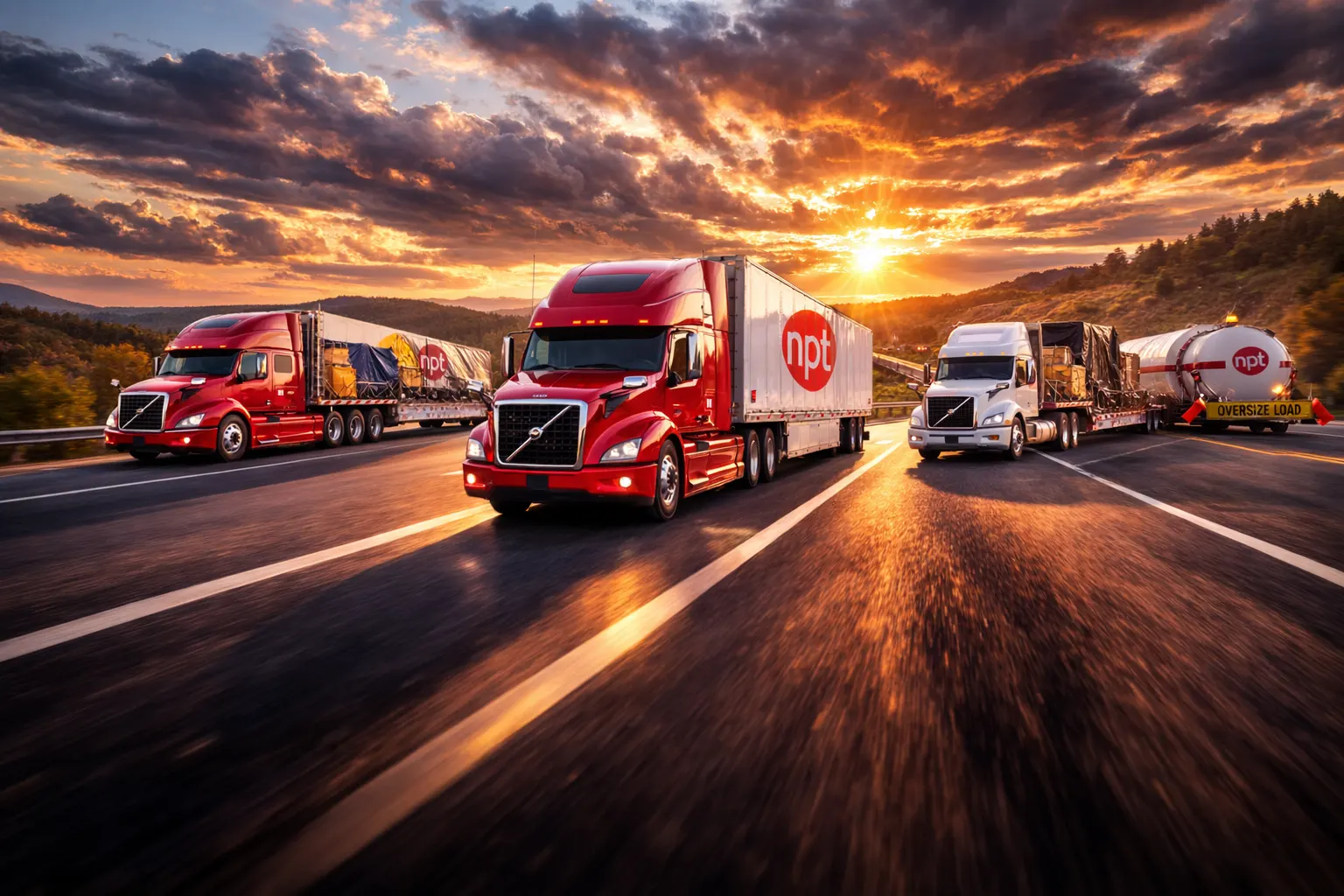
NPT moves truckload freight across Canada, the United States, and Mexico through a hybrid asset + brokerage model built for scale. Dry van, flatbed, RGN heavy haul, and Conestoga capacity delivered with appointment precision, secure trade compliance, and milestone-level visibility from dispatch through POD.
Built for lane consistency, clean handoffs, and faster exception recovery.
Dry Van Truckload | Enclosed Capacity for Retail, Automotive & Industrial Supply Chains
Dry Van is the industry-standard enclosed truckload solution for freight that does not require temperature control. It delivers full protection from weather, road exposure, and in-transit risk while supporting strict appointment compliance and OTIF performance. Designed for high-volume distribution and plant-to-plant lanes, dry van capacity is ideal for retail and CPG shipments, automotive parts, packaged goods, paper products, and general industrial freight moving across North America.
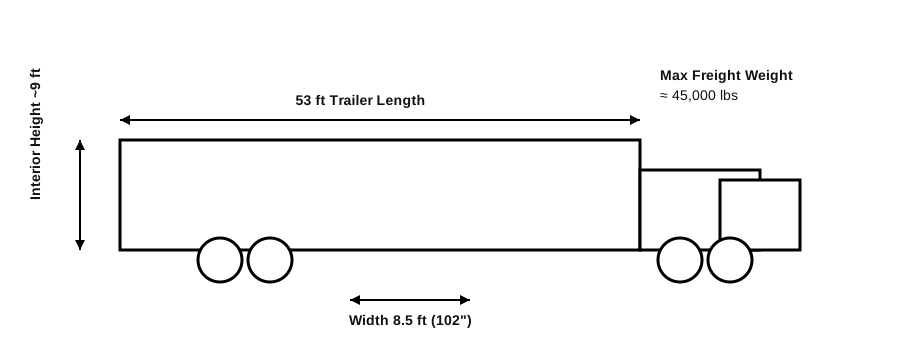
Technical Specs
- Length
- 53 ft trailer
- Width
- 8.5 ft (102 inches)
- Height
- ~9 ft interior clearance
- Max Freight Weight
- ~43,000-45,000 lbs typical legal payload
- Pallet Capacity
- Typically up to 26 standard pallets
Planning values only. Final legal fit depends on route, axle configuration, equipment, and applicable regulations; confirm at dispatch.
Dry Van Freight Fit Guide
Dry van trailers are the most widely used enclosed freight solution in North America. This guide helps determine if a standard dry van is the right fit for your load—and what to use instead when it isn't.
Small palletized shipments
If your freight is under 12 pallets or under 15,000 lbs, booking an entire truck may not be the most efficient option.
Freight taller than enclosed dry van limits or oversized
If your freight exceeds enclosed trailer height constraints or requires top/side loading for safe handling.
Freight requiring temperature control
If your cargo must remain within a controlled temperature range, such as food, pharmaceuticals, or perishables.
Freight requiring hazardous materials handling
If your shipment is classified as hazardous under transport regulations and requires placarding, documentation, or carrier credentials.
How to use this Service
Here’s how to use NPT’s Dry Van service from quote to delivery.
- Share pickup and delivery addresses, dock hours, and appointment process so we can plan the lane.
- Provide commodity description, NMFC/class if known, and any handling requirements.
- Give pallet count, dimensions or linear feet, and total weight so we can confirm trailer fit.
- Specify target service level, delivery window, and receiver constraints (e.g. appointment-only).
- Include reference numbers and documentation needs (BOL, POD, invoice) for clean handoff.
- Confirm exception protocol for detention, reconsignment, or missed appointments so we can respond consistently.
Operational Coverage & Service Standards
Operational coverage is structured to keep enclosed freight moving with consistent service standards.
- 53' dry van lane coverage across North America (CA-US-MX)
- Drop trailer and preload support where facility flow allows
- Appointment-sequenced retail and distribution routing
- Cross-border handoff coordination aligned to customs workflows
- Detention-aware planning and exception escalation protocol
- POD and documentation closeout discipline for clean billing
Get pricing and capacity for this mode
Share your lane requirements and we will return a structured quote with equipment fit, timing expectations, and operating assumptions.
- Equipment-fit and lane assumptions defined before tender
- Appointment, POD, and exception workflows aligned at intake
- Structured quote response within one business cycle
Dry Van shipper FAQs
Dry van execution is governed by appointment discipline, clean documentation handoff, and proactive exception management to protect OTIF performance.
- OTIF-driven executionAppointment compliance, receiver requirements, and disciplined lane governance—built for supply chain reliability.
- Hybrid capacity modelAsset-backed stability with broker-integrated coverage to protect service when volume shifts.
- Milestone visibility that mattersOperational updates aligned to decision points—exceptions escalated early, not discovered late.
Flatbed | Open Deck Truckload for Industrial & Project Freight
Flatbed is the standard open-deck truckload solution for freight that exceeds standard trailer dimensions or requires crane, side-load, or top-load access. It supports industrial and project-driven shipments where securement standards, route planning, and jobsite coordination directly impact schedule integrity. Common commodities include structural steel, lumber, construction materials, heavy equipment, machinery, and oversized industrial components moving across North America.
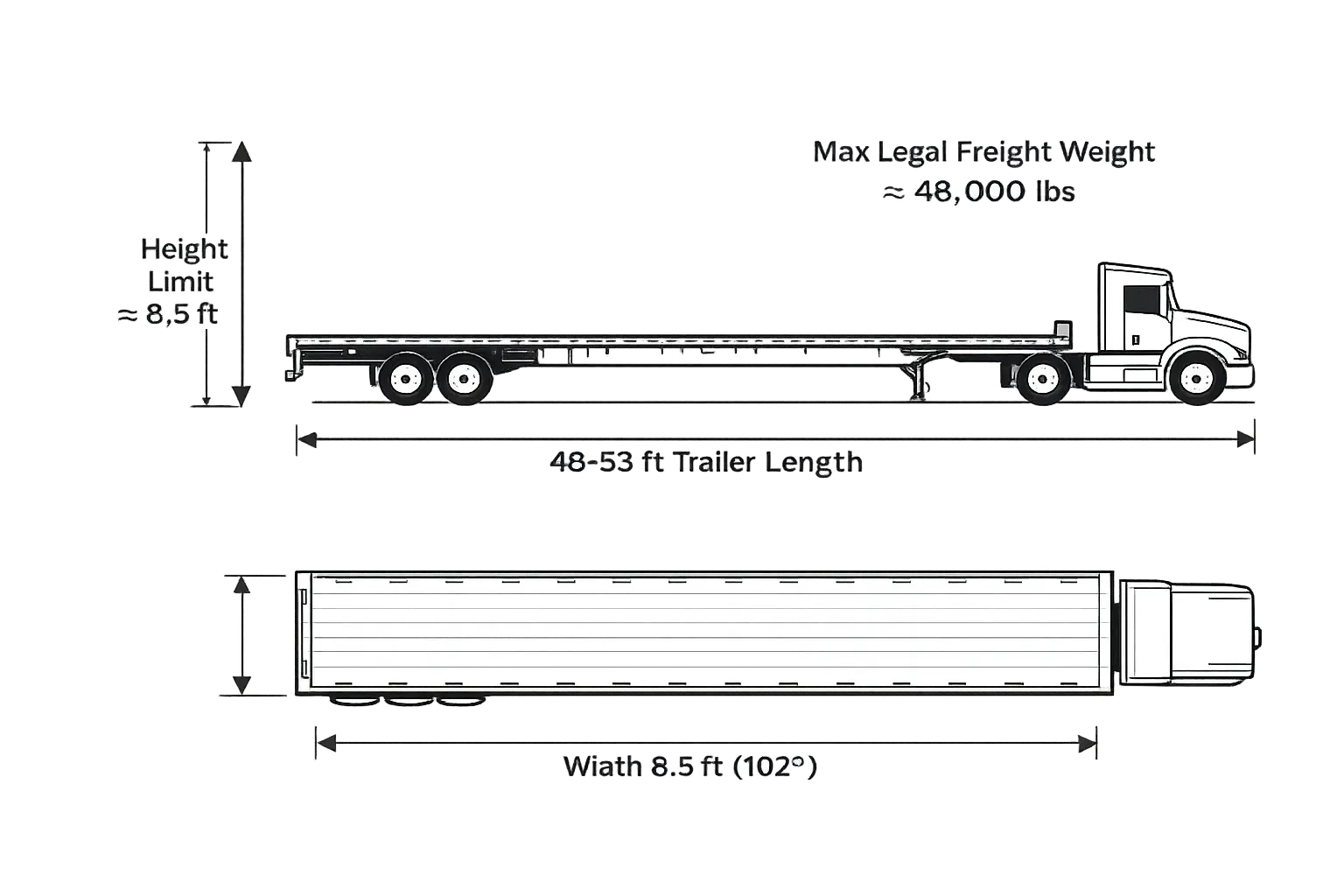
Technical Specs
- Length
- 48 ft or 53 ft deck (typical)
- Width
- 8.5 ft (102 in) deck width
- Height
- Open; no enclosed height limit
- Max Freight Weight
- Varies by axle configuration; typical legal payload ~43,000–48,000 lbs
- Pallet Capacity
- N/A — deck-loaded, not pallet-count driven
Planning values only. Final legal fit depends on route, axle configuration, equipment, and applicable regulations; confirm at dispatch.
Flatbed Freight Fit Guide
Flatbed trailers are built for freight that needs top, side, or crane access, or exceeds enclosed trailer dimensions. This guide helps determine if flatbed is the right fit for your load—and what to use instead when it isn't.
Small or palletized shipments that fit enclosed
If your freight fits inside a dry van and does not require crane or top-load access, enclosed transport is usually more efficient and weather-protected.
Oversize, overweight, or permit-required
If your load exceeds standard legal dimensions or axle limits and requires permits or specialized low-bed equipment.
Shipments under deck capacity
If your shipment is under roughly 12 linear feet or 15,000 lbs and does not need open-deck access, LTL may be more cost-effective.
Freight requiring temperature control
If your cargo must remain within a controlled temperature range, open deck is not suitable.
How to use this Service
Here’s how to use NPT’s Flatbed service from quote to delivery.
- Share exact dimensions, weight, and weight distribution or center-of-gravity so we can confirm deck fit and securement approach.
- Provide loading and unloading method, equipment on site (crane, forklift), and any access or height restrictions.
- Specify securement requirements, protection needs (tarps, blocking), and handling constraints for the commodity.
- Give appointment windows, jobsite protocols, and unloading sequence so we can plan driver and equipment timing.
- Confirm milestone update cadence and on-site delivery confirmation (sign-off, photos) so stakeholders stay aligned.
- Clarify contingency rules for weather, delays, or access changes so we can respond without rework.
Operational Coverage & Service Standards
Flatbed operations are structured for safer handling, schedule integrity, and jobsite coordination.
- Open-deck capacity for steel, lumber, machinery, and construction freight
- Securement planning aligned to cargo risk, route conditions, and safety standards
- Regional and long-haul execution for industrial and project freight
- Appointment-driven delivery coordination for live worksites and active facilities
- Detention-aware dispatch and milestone reporting for stakeholder alignment
- Cross-border flatbed support across CA–US–MX lanes
Get pricing and capacity for this mode
Share your lane requirements and we will return a structured quote with equipment fit, timing expectations, and operating assumptions.
- Securement planning before dispatch release
- Site access and loading window coordination
- Escalation path for weather and route exceptions
Flatbed shipper FAQs
Flatbed shipments succeed when handling, securement, and site conditions are planned—not guessed. Our process reduces exceptions, protects cargo integrity, and keeps stakeholders aligned.
- Securement governanceRisk is managed through disciplined securement planning aligned to commodity profile and route conditions.
- Jobsite and facility coordinationWe plan loading method, access constraints, and on-site handling to reduce delays and detention exposure.
- Permit- and route-aware planningConstraints are validated early to prevent avoidable rework, missed windows, and schedule drift.
Step Deck | Drop-Deck Truckload for Tall Cargo & Height-Sensitive Freight
Step deck (drop-deck) trailers have a lower forward section that reduces overall load height, allowing taller cargo to stay within legal height limits. Ideal when flatbed cannot accommodate load height or when you need extra vertical clearance for machinery, equipment, or structural components. Common uses include construction equipment, manufacturing machinery, and oversized industrial freight moving across North America.
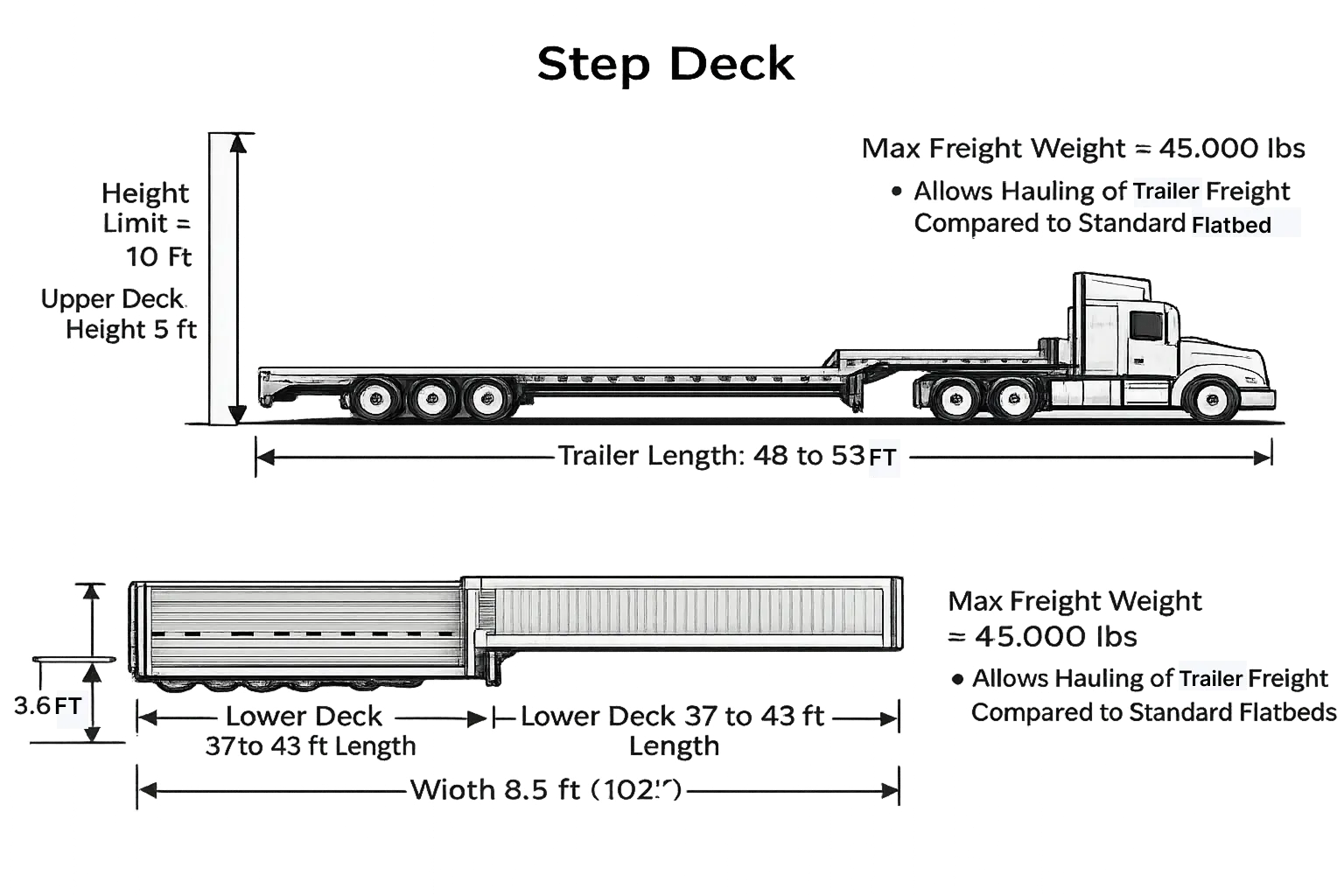
Technical Specs
- Length
- 48 ft or 53 ft typical; upper and lower deck sections
- Width
- 8.5 ft (102 in) deck width
- Height
- Lower forward section reduces overall height; varies by configuration
- Max Freight Weight
- Varies by axle configuration; typical legal payload similar to flatbed
- Pallet Capacity
- N/A — deck-loaded, not pallet-count driven
Planning values only. Final legal fit depends on route, equipment, and applicable regulations; confirm at dispatch.
Step Deck Freight Fit Guide
Step deck trailers are built for freight that needs extra vertical clearance beyond flatbed limits. This guide helps determine if step deck is the right fit—and what to use instead when it isn't.
Freight fits on standard flatbed
If your load fits on a 48–53 ft flatbed within legal dimensions and height.
Oversize, overweight, or permit-required
If your load exceeds standard legal dimensions or requires permits or specialized equipment.
Shipments under deck capacity
If your shipment is under roughly 12 linear feet or 15,000 lbs and does not need open-deck access.
How to use this Service
Here's how to use NPT's Step Deck service from quote to delivery.
- Share exact dimensions, weight, and center-of-gravity so we can confirm step deck fit.
- Provide loading and unloading method and any height or access restrictions.
- Specify securement requirements and handling constraints for the commodity.
- Give appointment windows and jobsite protocols for delivery coordination.
- Confirm milestone update cadence and on-site delivery confirmation.
Operational Coverage & Service Standards
Step deck operations combine height flexibility with open-deck securement discipline.
- Drop-deck capacity for tall machinery and equipment
- Height clearance optimization for legal compliance
- Securement planning for industrial and project freight
- Cross-border step deck support across CA–US–MX lanes
Get pricing and capacity for this mode
Share your lane requirements and we will return a structured quote with equipment fit, timing expectations, and operating assumptions.
- Deck fit and height clearance confirmed before tender
- Site access and loading method coordination
- Escalation path for weather and route exceptions
Step Deck shipper FAQs
Step deck adds vertical flexibility for loads that exceed flatbed height limits. We confirm deck fit, securement approach, and route feasibility before dispatch.
- Height clearance optimizationLower deck section reduces overall height for taller loads while staying legal.
- Equipment and route matchingWe match load dimensions and route constraints to the right step deck configuration.
- Securement and handlingOpen-deck securement planning aligned to cargo profile and jobsite requirements.
RGN (Oversize) & Heavy Haul | Oversize, Overweight & Permit-Controlled Transport
RGN and Heavy Haul services are engineered for freight that exceeds standard legal dimensions or axle weight limits and requires permit-governed execution. Designed for project-critical and high-value cargo, this mode integrates specialized trailer configurations, route feasibility analysis, axle distribution planning, and multi-jurisdiction compliance management. Typical shipments include construction and mining equipment, power generation components, transformers, and oversized industrial machinery moving across North America.
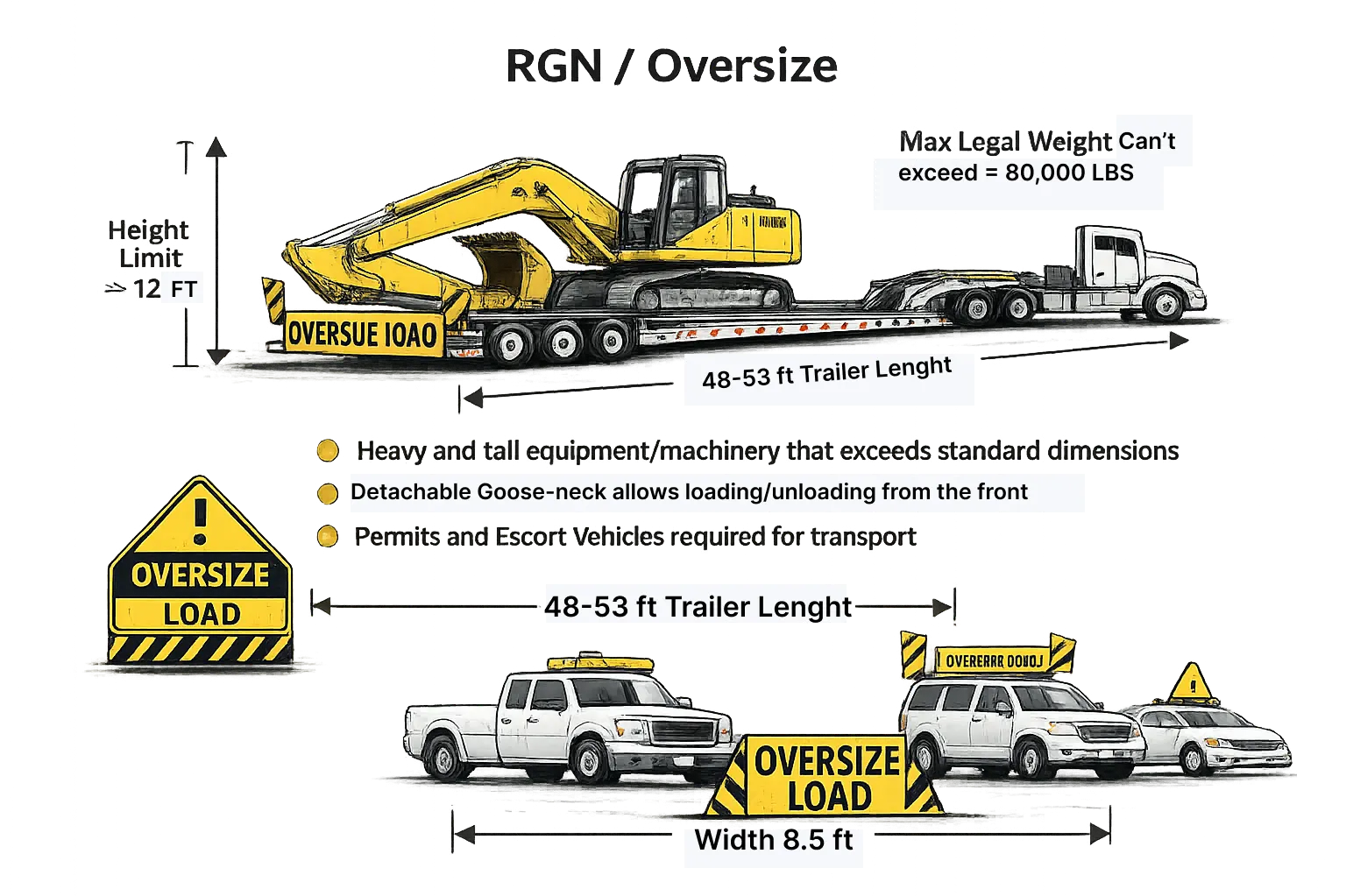
Technical Specs
- Length
- Variable; low-bed and detachable configurations to suit load
- Width
- Deck width varies; legal width and permit dimensions apply
- Height
- Low deck for tall cargo; height clearance is route- and permit-dependent
- Max Freight Weight
- Axle- and configuration-dependent; often 80,000+ lbs gross with permits
- Pallet Capacity
- N/A — project and dimension-driven, not pallet-count
Planning values only. Final equipment fit, permits, and legal limits depend on route, jurisdiction, and configuration; confirm at dispatch.
RGN (Oversize) Freight Fit Guide
RGN and heavy-haul equipment are built for freight that exceeds standard legal dimensions or axle weight limits and requires permit-governed execution. This guide helps determine if RGN or oversize is the right fit for your load—and what to use instead when it isn't.
Standard legal freight that fits enclosed
If your freight fits within dry van dimensions and legal weight, enclosed transport is typically more efficient.
Freight that fits on standard flatbed
If your load fits on a 48–53 ft flatbed within legal dimensions and weight without permits or specialized equipment.
Shipments under truckload scope
If your shipment is under roughly 12 linear feet or 15,000 lbs and does not require specialized handling.
Freight requiring temperature control
If your cargo must remain within a controlled temperature range, heavy-haul open deck is not suitable.
How to use this Service
Here’s how to use NPT’s RGN and Oversize service from quote to delivery.
- Share exact dimensions, axle weights, and loading diagrams (if available) so we can confirm equipment fit and permit scope.
- Provide pickup and delivery site access details for low-bed and specialized equipment so we can plan moves and staging.
- Specify jurisdictional constraints, permit timing requirements, and route limitations so we can sequence permits and avoid rework.
- Give escort requirements, safety protocols, and on-site coordination rules so we can align carriers and jobsite expectations.
- Confirm milestone checkpoints and decision-makers for escalation so we can keep the project on track.
- Clarify contingency protocol for permits, weather, and schedule variance so we can respond without delay.
Operational Coverage & Service Standards
RGN and oversize execution combines compliance rigor with disciplined operational control.
- Heavy-haul deck configurations for oversized and high-weight cargo
- Permit-aware planning with route feasibility and timing validation
- Risk-controlled execution for high-value and project-critical moves
- Multi-party coordination across shipper, jobsite, and operations stakeholders
- High-clarity milestone reporting and exception governance
- Cross-border heavy-haul support across CA–US–MX corridors
Get pricing and capacity for this mode
Share your lane requirements and we will return a structured quote with equipment fit, timing expectations, and operating assumptions.
- Permit and route sequencing support
- Pre-move risk review with compliance controls
- Milestone communication for every critical handoff
RGN (Oversize) shipper FAQs
Oversize moves require compliance and execution to run as one process. We manage permits, equipment readiness, and stakeholder alignment so timelines stay real and risk stays controlled.
- Permit and route engineeringMulti-jurisdiction permits and route constraints validated up front to protect schedule accuracy.
- Axle and weight managementLoad planning aligned to axle limits, distribution requirements, and safe handling tolerances.
- Risk-controlled executionEquipment checks, securement standards, and escalation protocols designed for high-value freight.
Roll-Tite / Conestoga | Covered Deck Truckload for Weather-Protected Open-Deck Capacity
Conestoga is a covered-deck truckload solution that combines full weather protection with the loading flexibility of an open trailer. It is purpose-built for freight that cannot be exposed to the elements yet requires side or overhead access for safe handling. Ideal for high-value industrial cargo and specialized equipment, Conestoga capacity supports crated machinery, aluminum products, engineered materials, and finished industrial goods moving across North America.
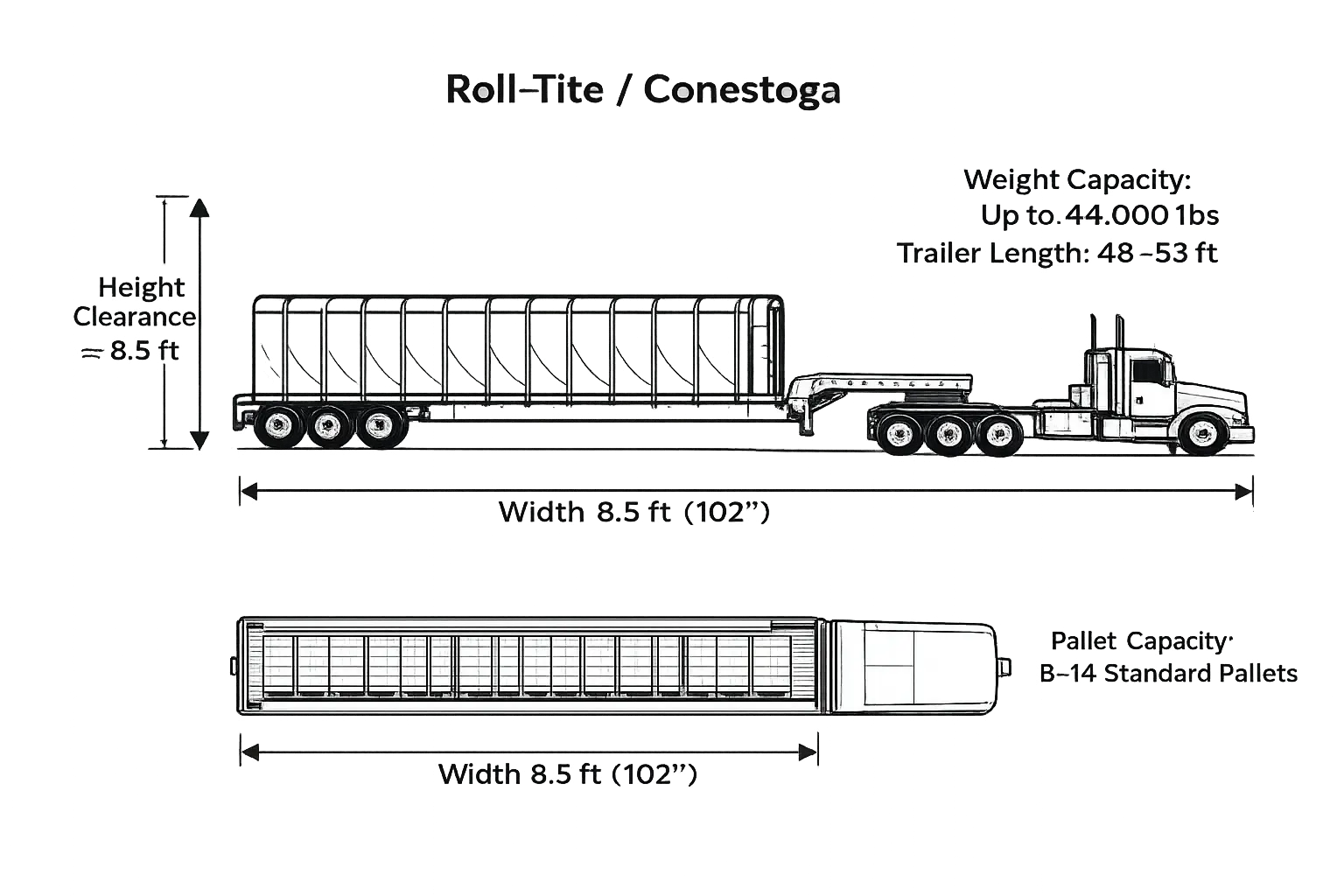
Technical Specs
- Length
- 48 ft or 53 ft covered deck (typical)
- Width
- 8.5 ft (102 in) deck width
- Height
- Covered; flexible clearance with roll-tarp or fixed cover
- Max Freight Weight
- Varies by axle configuration; typical legal payload similar to flatbed
- Pallet Capacity
- N/A — deck-loaded, not pallet-count driven
Planning values only. Final equipment fit depends on route, cover type, and load profile; confirm at dispatch.
Roll-Tite / Conestoga Freight Fit Guide
Roll-Tite and Conestoga trailers offer covered-deck capacity with side and top loading access—ideal when freight must be protected from the elements but does not fit or load efficiently in a dry van. This guide helps determine if Roll-Tite or Conestoga is the right fit for your load—and what to use instead when it isn't.
Standard palletized freight that fits enclosed
If your freight loads through standard dock doors and fits inside a dry van, enclosed transport is usually simpler and cost-effective.
Freight that can be exposed to weather
If your cargo can tolerate rain, road spray, or open-deck transit and does not need full weather protection.
Freight requiring temperature control
If your cargo must remain within a controlled temperature range; Conestoga provides weather protection only, not refrigeration.
Shipments under truckload scope
If your shipment is under roughly 12 linear feet or 15,000 lbs and does not require specialized handling.
How to use this Service
Here's how to use NPT's Roll-Tite / Conestoga service from quote to delivery.
- Share commodity sensitivity, packaging profile, and protection or securement requirements so we can plan cover and tie-down approach.
- Provide loading method and whether side-load or overhead access is required at origin and destination.
- Specify pickup and delivery constraints, site access, and unload conditions so we can match equipment and timing.
- Give target timeline, appointment process, and receiver compliance requirements for clean handoff.
- Confirm status cadence expectations and POD closeout requirements so stakeholders stay aligned.
- Clarify contingency rules for weather disruption and schedule variance so we can respond consistently.
Operational Coverage & Service Standards
Conestoga combines protection, flexibility, and operational control for sensitive freight programs.
- Covered-deck transport with open-deck style handling flexibility
- Securement and protection planning aligned to commodity risk and route conditions
- Regional and long-haul execution across North America (CA–US–MX)
- Weather-risk mitigation without sacrificing jobsite compatibility
- Proactive milestone updates and exception governance
- Cross-border support for protected freight programs
Get pricing and capacity for this mode
Share your lane requirements and we will return a structured quote with equipment fit, timing expectations, and operating assumptions.
- Covered-deck protection for weather-sensitive freight
- Load access flexibility with operational control
- Status cadence tailored to shipper requirements
Roll-Tite / Conestoga shipper FAQs
Conestoga execution is built around protection planning, securement standards, and site coordination—reducing damage exposure while preserving handling flexibility.
- Protection without compromiseCovered-deck transit for sensitive freight with open-deck loading flexibility.
- Handling controlSecurement and protection requirements defined before dispatch to reduce avoidable rework.
- Operational predictabilityMilestone reporting and exception governance built for time-sensitive industrial shipments.

Talk to our experts and choose the right freight mode.
Fast mode guidance for your lane, timing, and cargo profile.